How a map of 125 kofun grew into
467 kofun & two World Heritage sites
The Kofun Explorer Map launched on June 1, 2026 as a small map of about 125 burial mounds. Two months and 200+ updates later, it covers 467 kofun, all 56 World Heritage kofun of two UNESCO sites, and 900+ bilingual pages. This page records what got easier — and when.
The Map Today — Main Features
Two months of steady updates add up to this. Tap any card to try the feature.
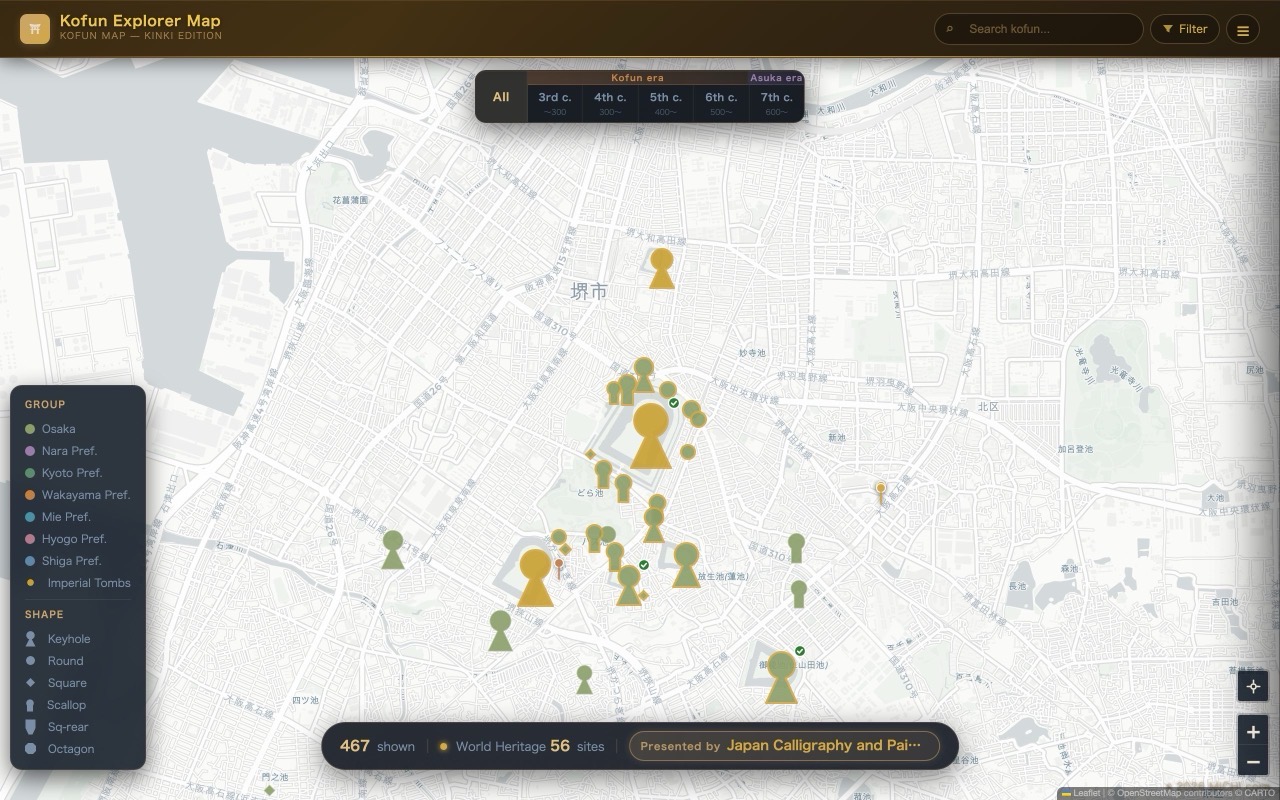 🗾 Interactive map (467 kofun)Marker shapes tell you the mound type — keyhole, round, square — and a gold ring means World Heritage. Filter by era, shape, prefecture and type.Open the map →
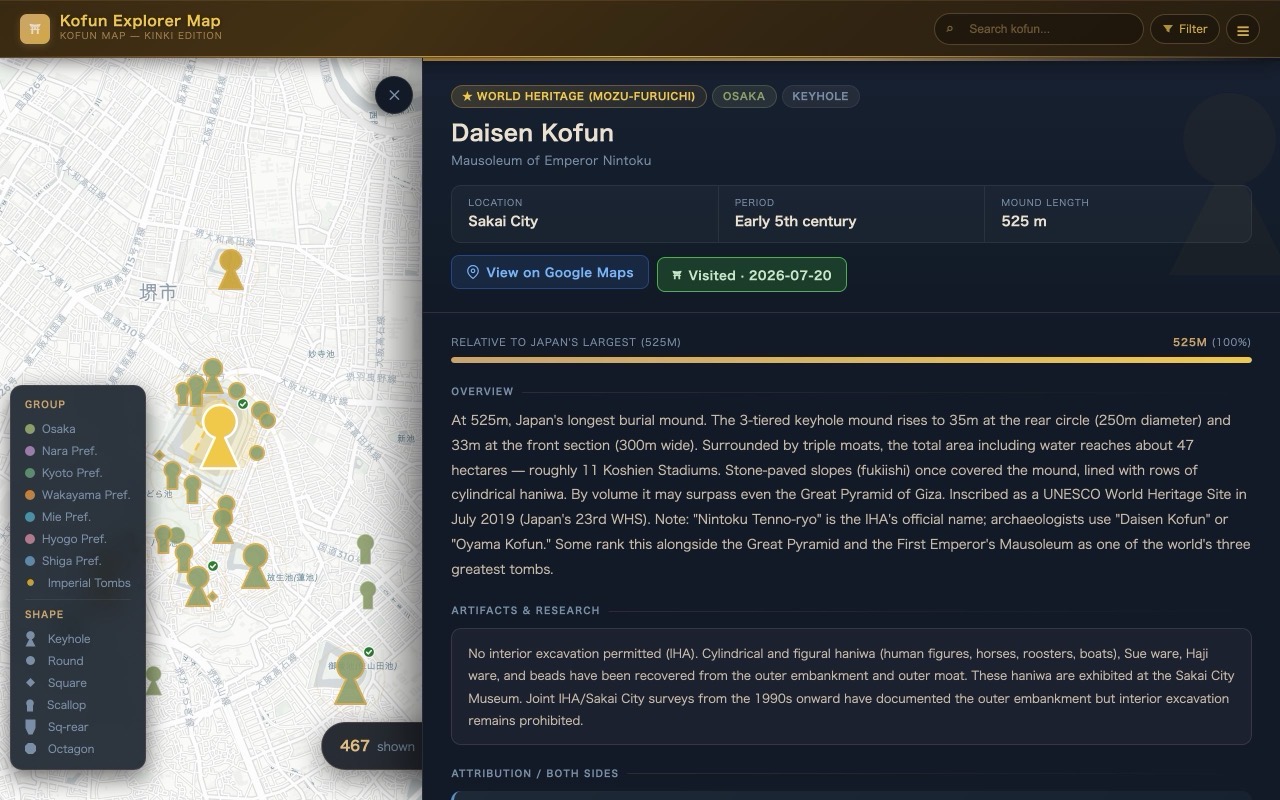 📖 Detail panel + true-scale outlineSelecting a kofun draws its real footprint on the map — "that whole forest is the tomb." Every entry presents both the Imperial Household Agency and archaeological views, with sources.See the Daisen Kofun example →
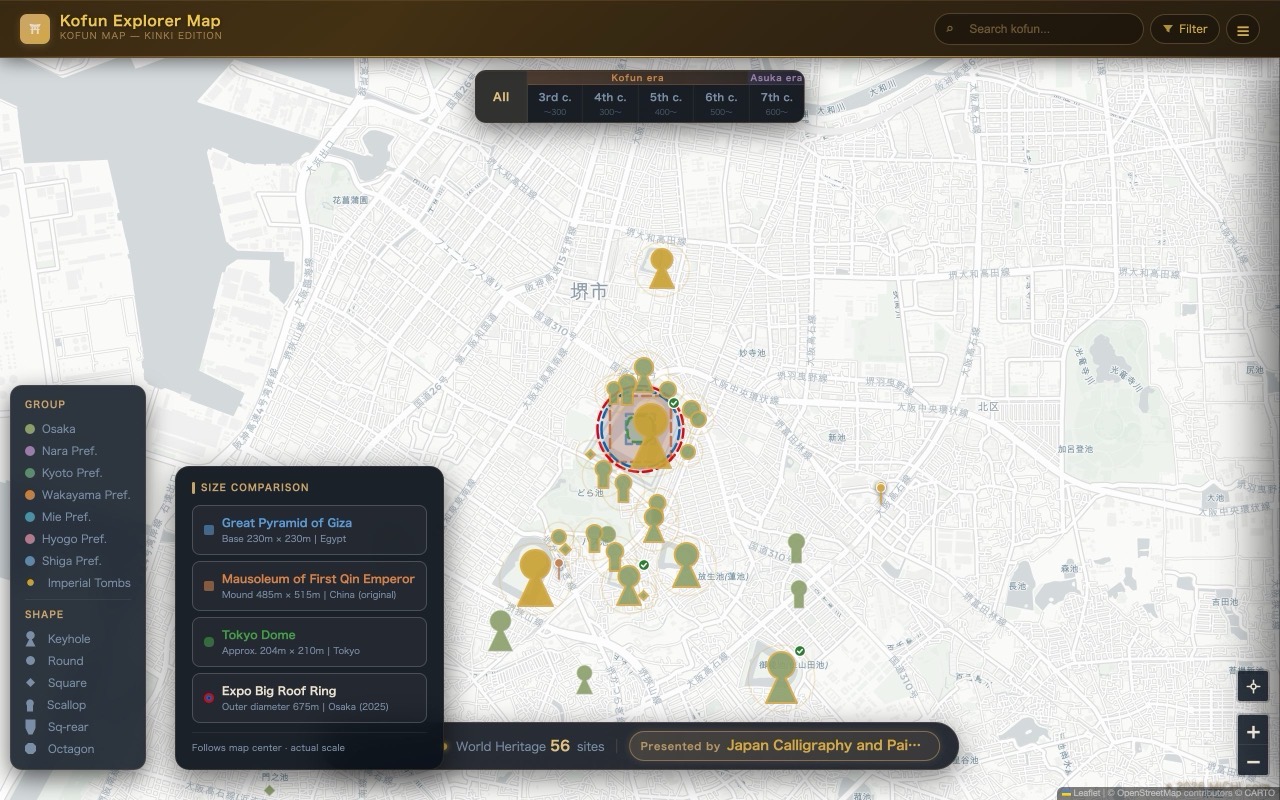 📐 World's-three-great-tombs comparisonOverlay the Great Pyramid of Giza, the First Qin Emperor's mausoleum, Tokyo Dome and the Expo 2025 Grand Ring at true scale — and see why Nintoku's tomb is called the world's largest.From the menu: "Compare" →
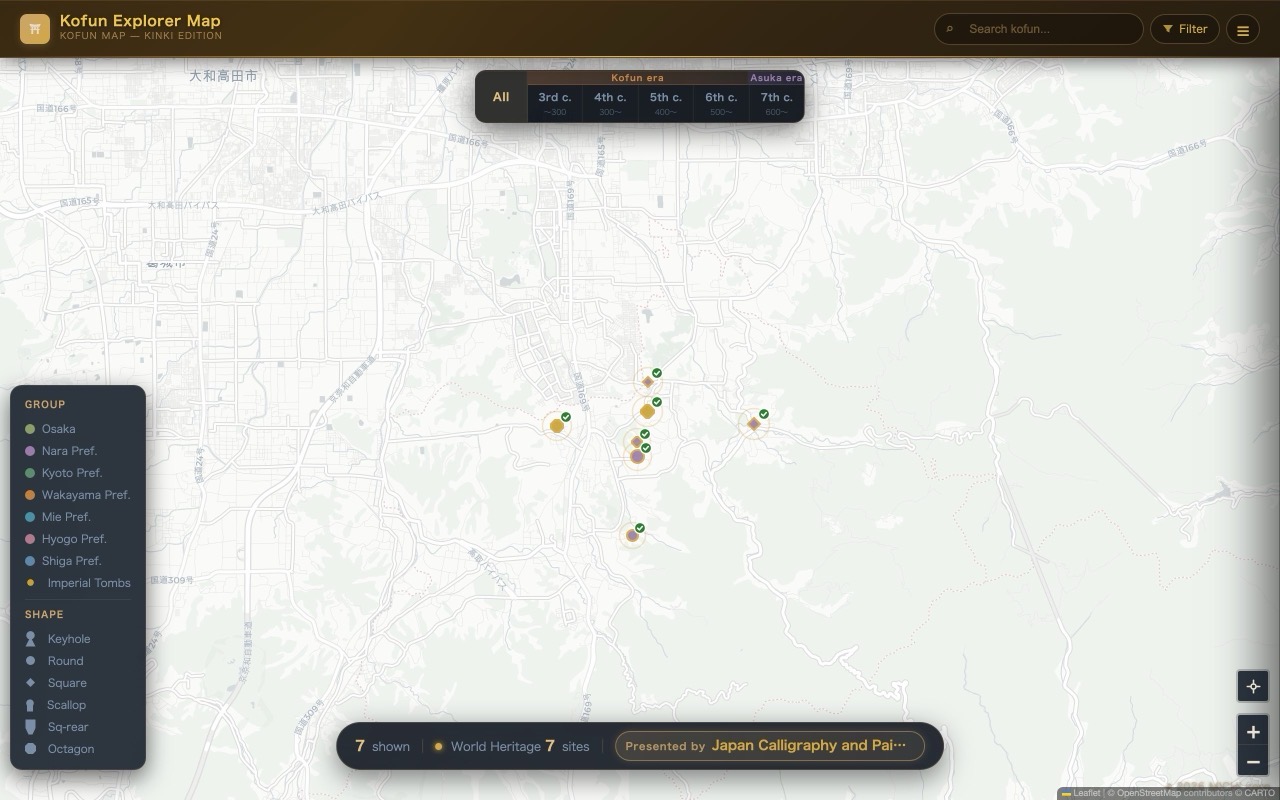 ★ World Heritage filters (2 sites)One tap narrows the map to the 49 Mozu-Furuichi kofun or the 7 of Asuka-Fujiwara — shareable as URLs (?wh=asuka / ?wh=mozu).Show the 7 Asuka-Fujiwara kofun →
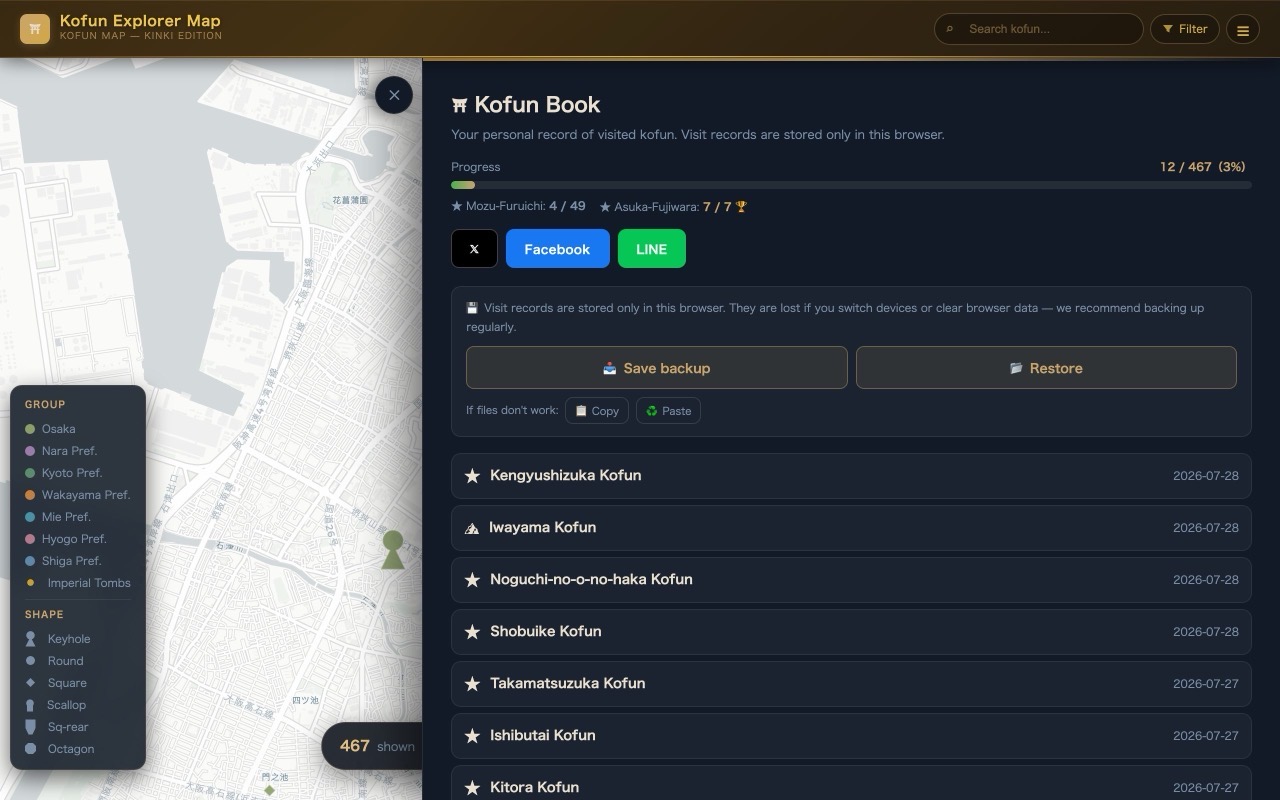 ⛩ Kofun Book (visit log)Record the kofun you visit and track your progress — including completion trophies🏆 for both World Heritage sites, social sharing, and one-tap backup & restore.From the menu: "Kofun Book" →
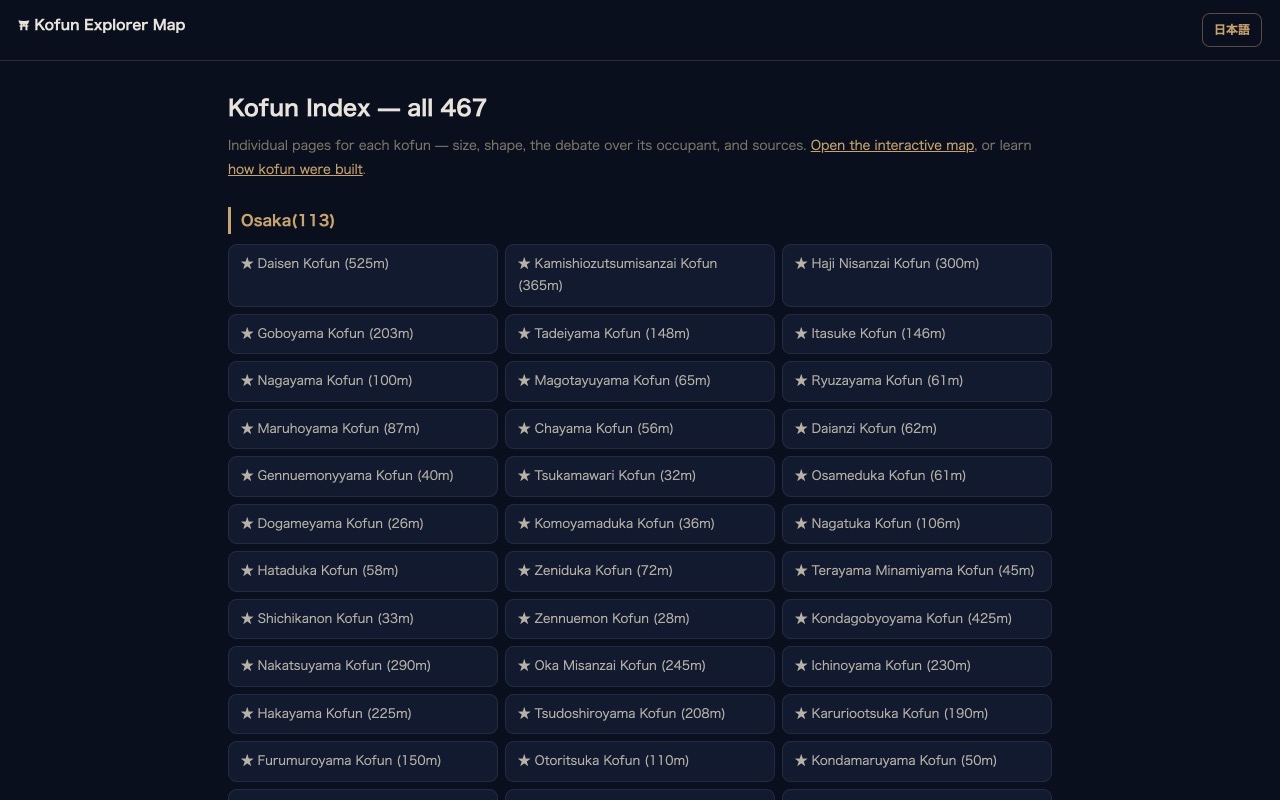 📚 Encyclopedia indexEvery one of the 467 kofun has its own article page — finds, occupant debates, visiting notes — fully bilingual and sourced.Browse the index →
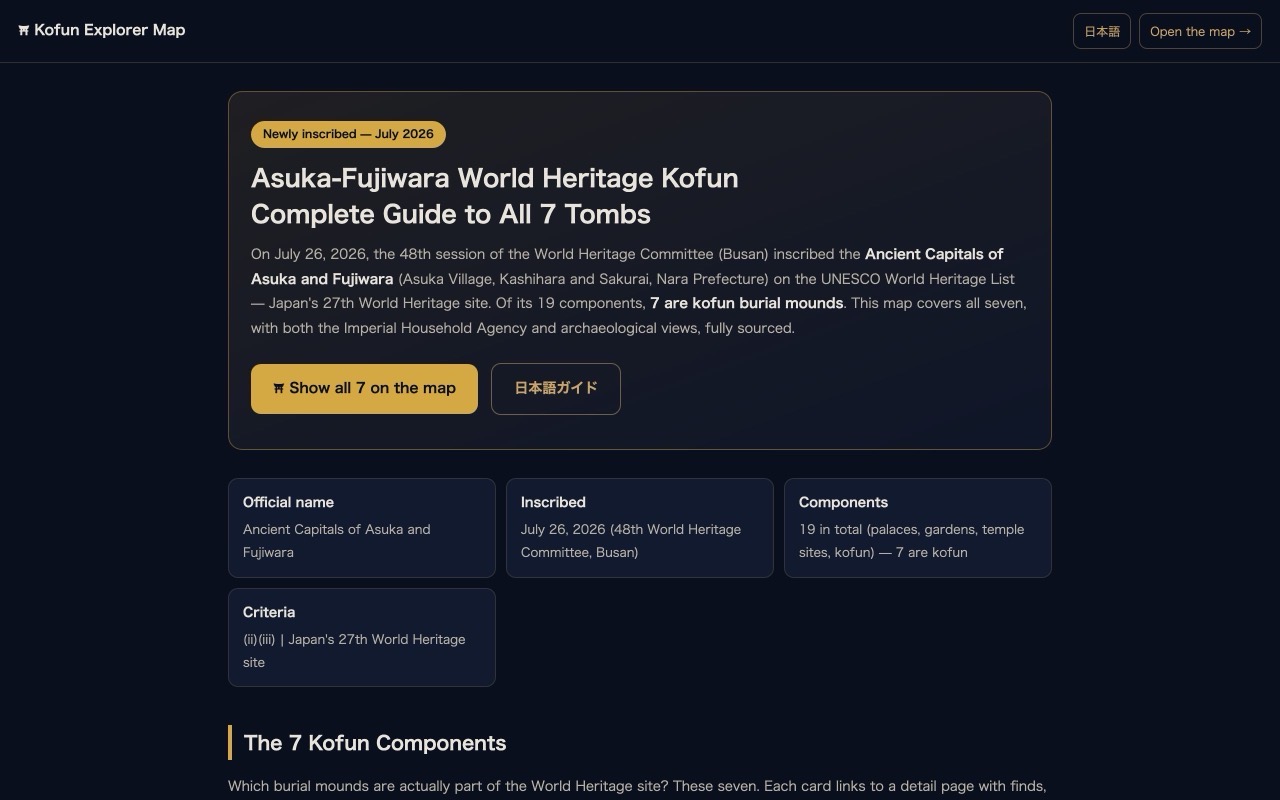 🎉 Special guide: Asuka-Fujiwara (2026)Published three days after inscription. Cards for all 7 kofun components, cycling model courses, and how to enjoy an "invisible heritage."Read the guide →
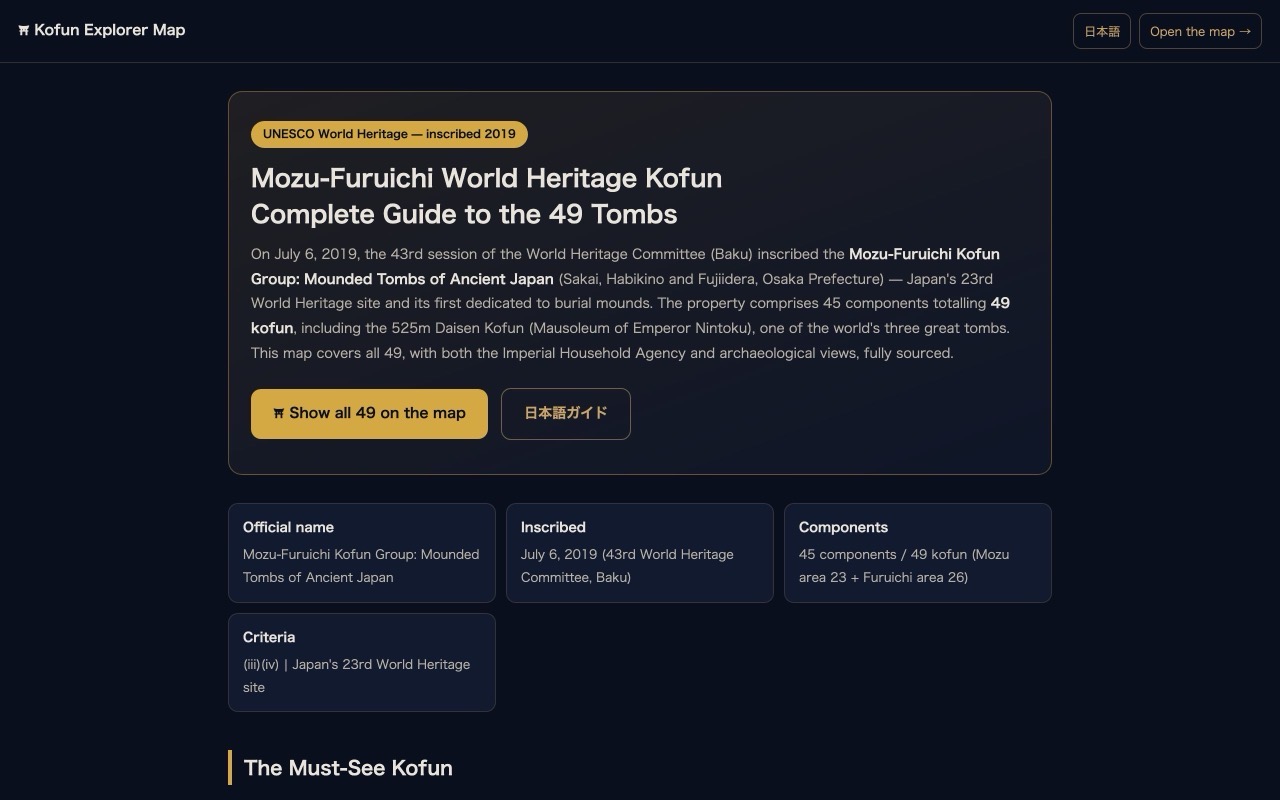 🏛 Special guide: Mozu-Furuichi (2019)The must-see giants, viewpoints, how to see tombs "too big to see" (go up, step back, compare), and half-day courses for both areas.Read the guide →
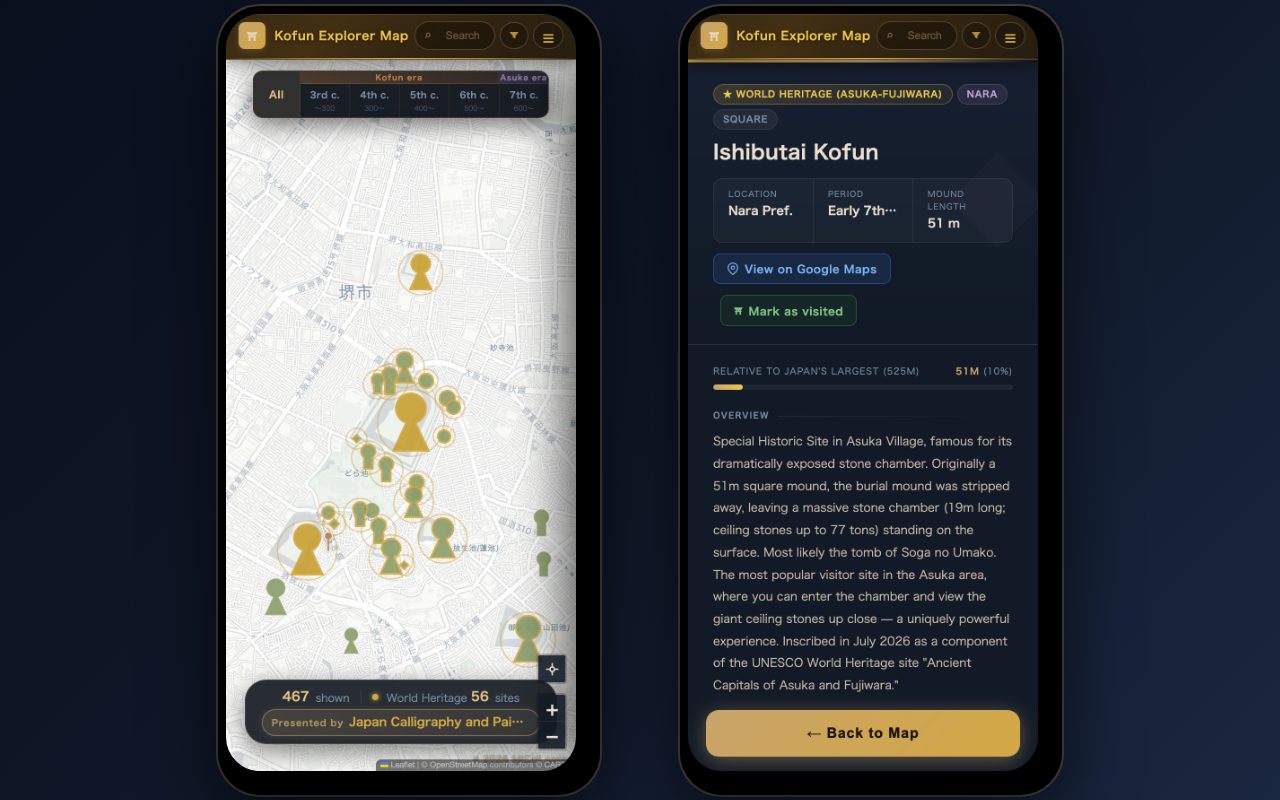 📱 Optimized for phonesA mobile UI built for on-site exploring — thumb-friendly layout, visit-log button, and "Add to Home Screen" for an app-like experience.Open on your phone →
Coverage Over Time — From 125 to 467 Kofun
launchJun 3Jun 5Jun 11Jul 18
today
This is a curated map, not an attempt to cover all ~160,000 kofun nationwide: we select those that meet our listing criteria and verify each with two or more independent sources.
Timeline
⛩ v1.0 launch — about 125 kofun
Born as a bilingual map where clicking a mound opens its story. From day one, every entry has shown both the Imperial Household Agency's and archaeologists' views side by side.
🌍 Compare with the world's great tombs at true scale
A comparison overlay added the Great Pyramid and the First Qin Emperor's mausoleum at real size (Tokyo Dome and the Expo Grand Ring came later) — making "the world's largest tomb" something you can see. The haniwa cursor also debuted.
Size comparisonHaniwa cursorSEO groundwork
🔗 kofun-map.com — every kofun gets a shareable URL
Moved to a custom domain on Cloudflare Pages, with ?id=… links that open any kofun directly. "Look at this one" became a single URL. The supporter page and privacy policy also went live.
🗾 Expansion across Kinki — 137 → 289 kofun
Kyoto, Wakayama and Mie joined in one sweep, making it a true map of the Kinki region. The era timeline bar (Kofun / Asuka periods by century) and the sortable list page arrived, and complete coverage of imperial mausolea began.
Kyoto / Wakayama / MieEra filterList page📍 "What's near me right now?"
Current-location display and a nearby-kofun filter — open the map on a trip and the mounds around you appear. Kana search, font-size settings and gold highlighting of the selected marker all landed the same week.
LocationKana searchFont size👑 Imperial mausolea became visitable information
Official visiting details (address, access, hours, where the tomb seals are kept) added for 28 mausolea, plus an imperial-tombs filter and the octagonal-mound marker shape.
IHA visiting infoImperial filterOctagonal mounds🤝 The supporter program began — support engraved on the map
Supporters' names now appear as map pins and a support strip (individual supporters from ¥550/month) — patronage of culture, displayed beside the tombs themselves. Coverage reached 358.
Supporter pinsIndividual supporters🎯 A big investment in accuracy — 333 coordinates verified
333 kofun coordinates were batch-verified against Google Places. Selecting a kofun now draws its true-scale footprint outline — "that entire forest is the tomb," made visible.
333 coordinatesTrue-scale outline📖 The Kofun Book and article pages for every kofun
The Kofun Book (visit log) and individual article pages for every kofun (900+ bilingual pages) arrived. Every entry was cross-checked so that only what is verified by two or more independent sources gets listed.
Kofun BookArticle pagesSourcing
✅ Criteria documented & full 7-prefecture coverage — reaching 467
Hyogo and Shiga joined, the selection criteria were published on the site, and every kofun meeting them (imperial mausolea, Special and National Historic Sites) was included across all seven prefectures. Two independent sourced references per kofun, and five automated quality gates on every data update.
Hyogo / ShigaPublished criteriaQuality gates🎉 Two World Heritage sites — three days after Asuka-Fujiwara's inscription
On July 26 the Ancient Capitals of Asuka and Fujiwara were inscribed. Within three days: World Heritage badges for the 7 kofun components (Ishibutai, Takamatsuzuka, Kitora…), per-site filters, bilingual special guides for both Asuka-Fujiwara and Mozu-Furuichi, and completion trophies in the Kofun Book.
2 sites / 56 kofun2 special guidesWH completion
Listing Criteria — Which Kofun We Include
This is not an attempt to cover all ~160,000 kofun nationwide, but a curated selection: meaningful kofun, presented with reliable information. We include a kofun if it meets any of the following.
- All 49 components of the "Mozu-Furuichi Kofun Group" and all 7 kofun of the "Asuka-Fujiwara" World Heritage sites
- Imperial mausolea, candidate mausolea and major satellite tombs designated by the Imperial Household Agency (this category covers the whole country)
- Designated cultural properties such as Special and National Historic Sites
- Academic importance — those appearing in textbooks and standard references
- Visitor value, such as an enterable stone chamber or a maintained park
- Scale representative of its region
Quality standard: a new entry is listed only when its shape, scale, location and designation can be confirmed by two or more independent sources (local governments, the Agency for Cultural Affairs, the Nara National Research Institute for Cultural Properties, Wikipedia, etc.). Where sources disagree, both views are shown; unverifiable figures are omitted. Kofun whose mounds no longer survive are included when academically important, clearly marked as "no longer extant."
These criteria are always available from the map menu under "📋 Selection Criteria."